Radiant
Radiant is a serverless, AI-powered tool that transforms raw Valorant gameplay into edited montages — complete with highlight detection, transitions, background music, and AI-generated commentary.
Motivation
As life got busier through grad school and career pursuits, I found myself drifting away from gaming — something that had always been a core hobby of mine. When my Masters Cloud Computing final gave me the freedom to choose a project, Radiant felt like the perfect opportunity to bridge what I was studying with what I genuinely enjoyed. It let me go deep on AWS and serverless architecture while building something I actually wanted to use.
How It Works
A user uploads a ~4 minute Valorant clip through the web interface . From there, the pipeline takes over:
- The video lands in S3, which triggers an EventBridge rule to kick off a Step Functions state machine.
- A custom Rekognition model scans the footage at 1 fps to detect kill events.
- Detected kill timestamps are merged into intervals and passed to the editing stage.
- FFmpeg extracts highlight clips, applies crossfade transitions, and layers in a randomly selected NCS background track.
- Amazon Bedrock generates hype commentary for each clip, which Amazon Polly synthesizes into speech and overlays on the video.
The finished montage is stored in S3 and served back to the user via presigned URLs.
Architecture
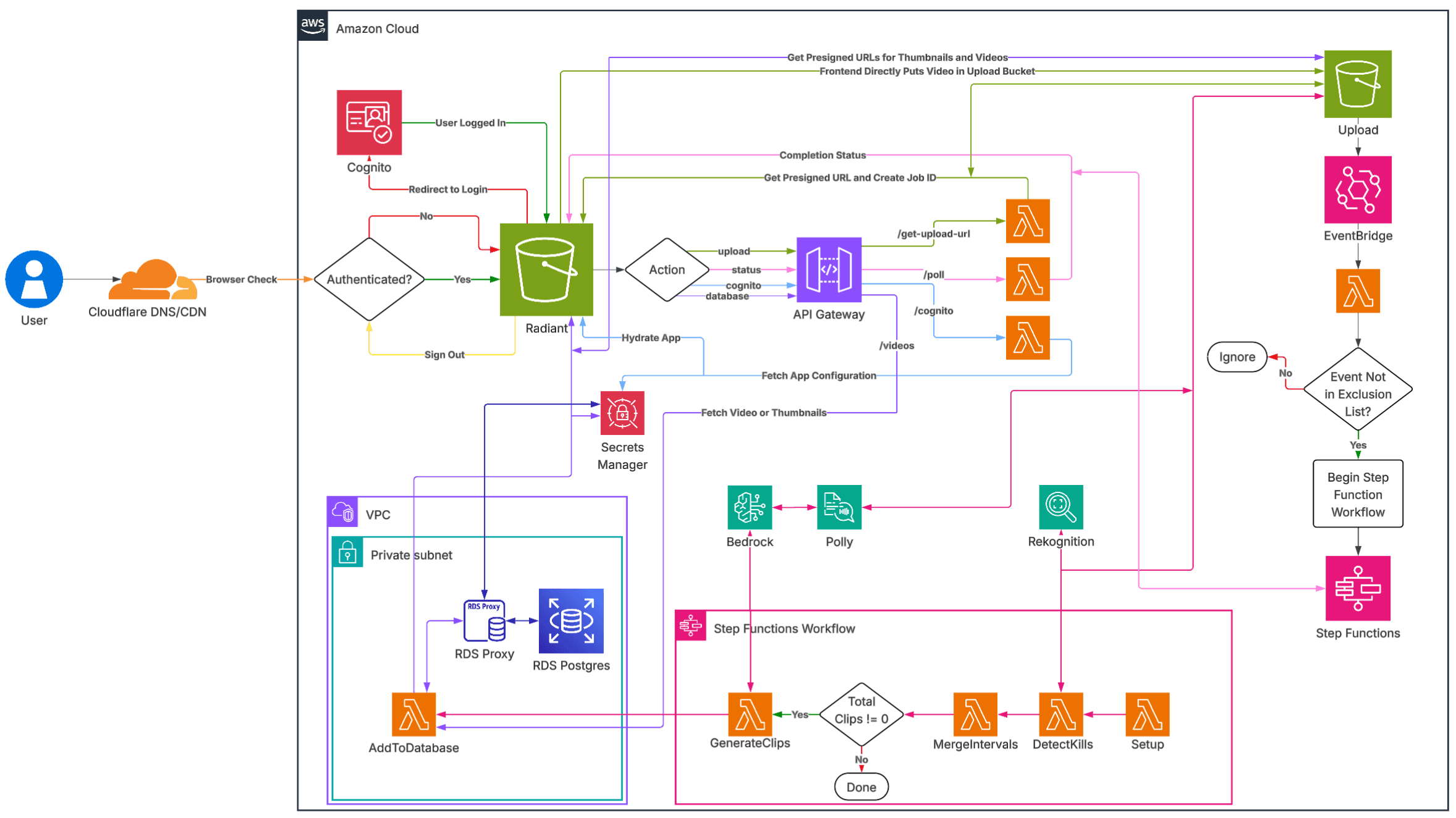
The entire backend is serverless. Four Python 3.12 Lambda functions — Setup, DetectKills, MergeIntervals, and GenerateClips — are orchestrated by Step Functions. API Gateway fronts the REST API, and Cognito handles auth with both username/password and Google OAuth support.
On the data side, PostgreSQL 17 on RDS (accessed through RDS Proxy for connection pooling) tracks users, jobs, and video metadata. The Next.js frontend is deployed to S3 behind Cloudflare for CDN and SSL. All infrastructure is managed with Terraform.
Infrastructure Automation
Having already taken my professor's DevOps class, he challenged me to fully automate Radiant's deployment. I took that challenge — the entire infrastructure is ~95% automated with Terraform provisioning AWS resources and Python scripts orchestrating Bash to handle everything from building Lambda layers to syncing the frontend to S3.
Challenges
- Lambda gives you 512 MB of
/tmp, which is not much room to edit video in. The whole pipeline had to run in memory with no intermediate writes to S3 — a constraint that shaped the design more than any of the services did. - Building a custom FFmpeg Lambda layer with x264 support compiled for Amazon Linux 2023 required Docker-based cross-compilation.
- Training Rekognition Custom Labels to reliably detect kill feed events across different agents, skins, and UI states took several iterations.
In the end it was one the projects I was most proud of!